

What mindfulness is – and what it isn’t
This image of a young woman meditating, sitting in the lotus position in white clothes by some lake, smiling happily as she gazes at the sunset… IT ANNOYS ME!
Of course, as a meditation teacher, I have reflected on this very mindfully. 😉
Here you can find out what bothers me about it and why such images often do more harm than good.
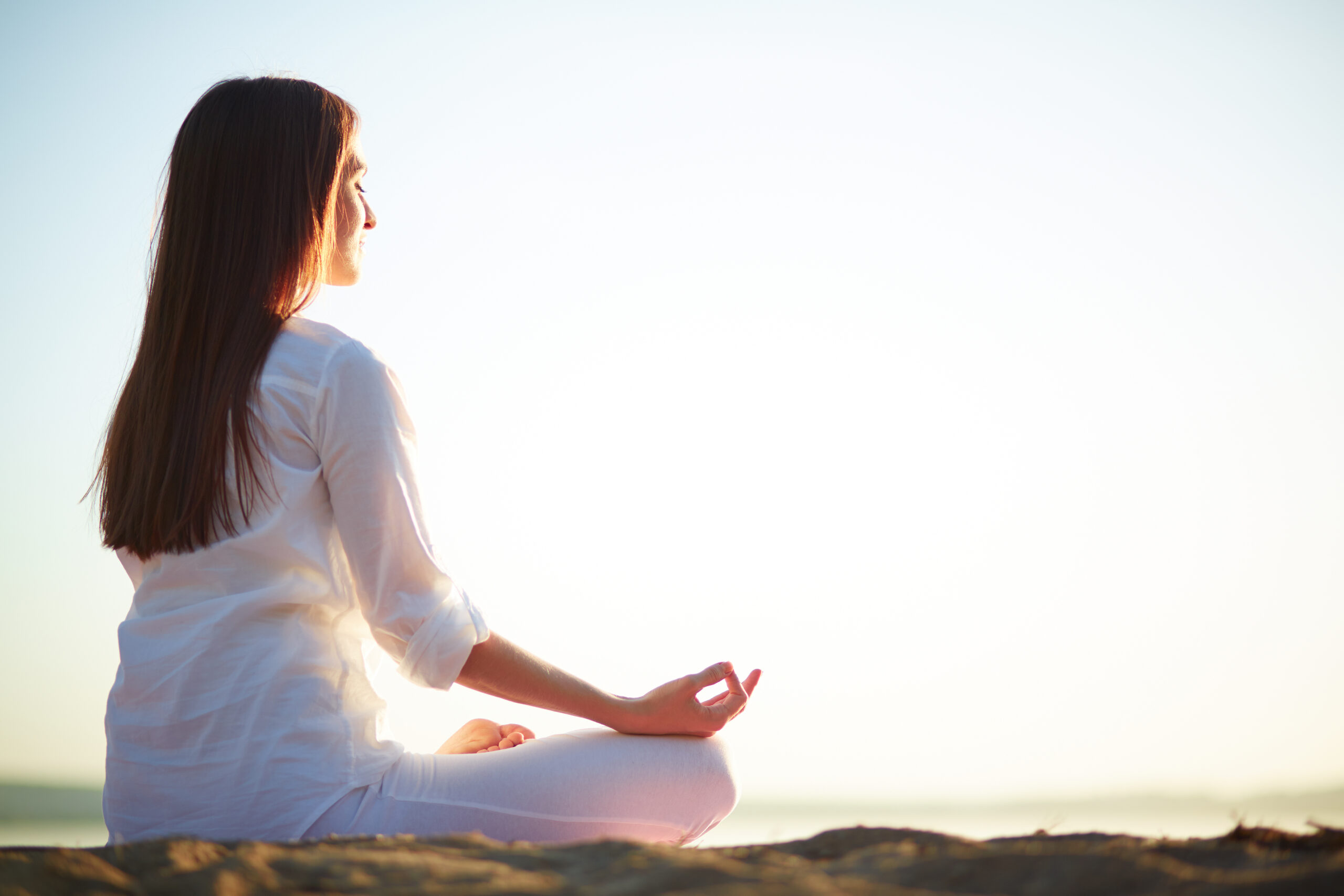
Is that meditation?
Image by pressfoto on Freepik
Mindfulness is about things you cannot see
It is about perception, non-judgment, and being in the moment—or returning to it again and again. Jon Kabat-Zinn, founder of the MBSR (Mindfulness-Based Stress Reduction) program, describes mindfulness as follows:
“Mindfulness is the awareness that arises
when we focus our attention in a particular way:
without intention
in the present moment
and without judgment.”
White clothing, lotus position, and a dreamy smile: all optional!
And as for the lake at sunset, I can only say: beware of the mosquitoes!
Seriously, why do I think this image is so unfortunate? Because it creates completely false expectations in so many people about what meditation and mindfulness actually are. It starts with external ideas about how it should look and continues with the assumption that there is also something right and wrong to do internally.
For example, a very common opinion is that when meditating, thoughts (should) stop. Nope! It CAN happen that they become calmer – and that is of course pleasant. But that’s not what it’s primarily about! However, many people find that their thoughts actually become louder at first, and then say: “I just can’t meditate. I simply can’t switch off. I have thoughts in my head all the time. I can’t do it. It’s not for me.“ And that’s such a shame!
Many stressed people give up because of misconceptions
In doing so, they forego training their attention and experiencing what it does to consciously bring their senses back inside again and again. (Important: ”Again and again” – repetition makes it practice!) And to learn to be present even with things that are unpleasant. To learn to “hold” this (not ‘endure’ it!). If you give up too quickly or identify with “not being able to,” you also miss the chance to experience how your nervous system often calms down on its own over time. (Insider tip: Trying to force relaxation doesn’t work. Unintentional presence, on the other hand, almost always has a relaxing and calming effect).
The ability to concentrate, to feel yourself, and to be patient with your own inner reactions: these are gifts of mindfulness that we urgently need today in a chaotic, loud, impatient, and often unappreciative world! They are a gateway to our own inner selves, where the key to a happy, fulfilled, meaningful, and self-determined life lies. It is valuable to learn that we have this key within ourselves and can specifically access our resources!
Of course, meditation cannot solve everything
Mindfully perceiving the disorder that currently reigns in a room does not make the room tidy, no matter how mindful we are. That is why it is also important to (re)develop a healthy relationship with active doing. To find out what is really important, relevant, and right for us right now.
In many moments of our lives, we succeed in doing this effortlessly, because we are in harmony with ourselves. But in other areas or situations in our lives, it can be very difficult because we stand in our own way or the circumstances are challenging.
Then it is good to have practiced mindfulness from time to time. Because it is about bringing this ability to be mindful into real life, not just staying on the meditation mat (or other ideal, quiet place). Otherwise, it would be sterile, but it’s about liveliness! And about how this liveliness wants to express itself individually in each of us.
We need symbolic images, but…
… in my opinion, it is high time to finally free the young woman in the white dress from the mosquitoes and muscle cramps in her legs and see the image for what it is: a cultural stereotype of meditation that has about as much to do with the deep essence of mindfulness as a Hollywood schmaltzy romance has to do with real love. Symbolic images are often useful and sometimes even helpful when they remind us of a deeper essence within ourselves. But sometimes images can also be harmful because they refer to a superficial or rigid idea – and then it is important to question them. In Buddhism, this goes one step further: “If you meet the Buddha – kill him!” Or, to put it in more pacifist terms:
“Don’t follow in the footsteps of the masters, but seek what they sought.”
Question your image of mindfulness
Where, how, and when would you like to be more mindful, even if it doesn’t fit the typical images of mindfulness?
It is possible to drive mindfully, write an unpleasant email, comfort a crying baby, or stand up to a defiant teenager, observe the rising anger in an argument, take a shower, plan your next vacation, go shopping, or cook.
Just give it a try! The three magic ingredients are: awareness, non-judgment, and presence. Add a pinch of kindness toward yourself when it doesn’t “work.” There is no right or wrong. Mindfulness is a way to get to know yourself better. And to cultivate a good relationship with yourself. Because: please don’t compare yourself to others! (Fortunately) you can’t see the carousel of thoughts in other people’s heads.
Practical tip: Approach it without expectations and images influenced by outside sources!
Just sit on your couch for 5 minutes before going to bed. Make yourself comfortable – you just need to be able to breathe freely. Then observe how your breath feels.
How it comes and goes. How your thoughts and feelings also come and go. And perhaps after a while you will notice that there is a calm layer deep within you. That is where inner silence lies. That is the source of your inner wisdom. That is where playful curiosity and wonder at the miracle of your breath, your body, and your life reside.
It may be (and probably is!) that above this—in various other layers—there is also restlessness and a jumble of thoughts, intense feelings, or unpleasant physical sensations. That is also part of life. And, whenever it shows up, it is part of the moment.
But there is a part of you that can hold all of this (sometimes maybe only for milliseconds, but that already makes a big difference!). It observes mindfully and kindly. And lets you know when something is not right. Sometimes it also sends you impulses on how you can make your life happier, more authentic, more fulfilling, and more meaningful. What is good for you and what is not.
Are you ready to listen to your inner voice and truly be alive?
If you answer yes to these questions, you can meditate!