
Self-Leadership: Core Competency in the AI Era
Self-leadership—that sounds like even more responsibility. A little heavy, a little cumbersome. But in reality, it is the key to our human freedom and self-determination. We all have the ability to do this within us—but in the age of AI, it must be consciously cultivated so that we don’t succumb to a whole new kind of stress and overload caused by our own curiosity.
Let me start with an anecdote: Recently, I was speaking in a course on resilience at work, full of enthusiasm and excitement about self-leadership and my ten strategies for it (see below). But at some point, I noticed that the mood was becoming increasingly heavy. I asked what was wrong. Finally, one participant said, “Phew! I’m already drowning in tasks, and now I’m supposed to lead myself too!?”
That’s exactly why I’m writing this article: Because self-leadership is by no means just another “to-do” – it’s an attitude or a principle for living! When understood correctly, it actually provides clarity, ease, and meaning – especially in a world that, thanks to AI and various other challenges, is not only VUCA (volatile, uncertain, complex, ambiguous) but also BANI (brittle, anxious, non-linear, incomprehensible)!
A new kind of stress: AI as a driver of exhaustion
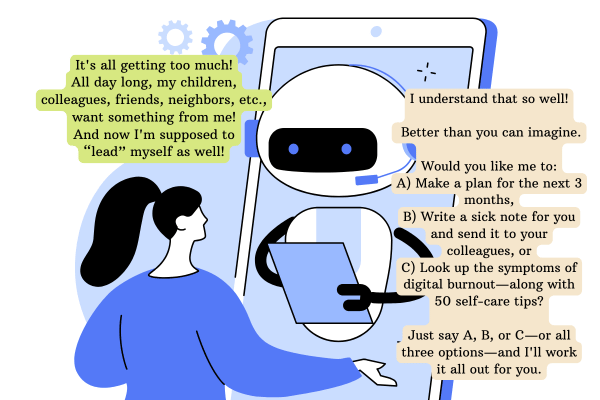
You only need to work with AI for a few days to see how it affects you when AI raises new questions and offers to continue at the end of every results presentation: At first, it feels great. But at some point, you become increasingly restless—and eventually realize that you’ve landed in a “rabbit hole” whose purpose is to keep your attention captive.
The human brain responds strongly to AI because it loves stimulation and curiosity. But the same pattern also quickly leads us to total overload!
This type of stress is a new experience for the human brain. Studies have already shown that frequent use of AI weakens critical thinking. At the same time, AI has already become indispensable in most areas of the working world. We must and can learn to deal with it.
Ancient philosophical wisdom as a “future skill”
It is also important that we understand the added value of our human work as well as the opportunities offered by AI. Otherwise, we lose touch with ourselves and our sense of purpose and effectiveness. And if we do not confidently shape and “lead” our lives and careers, we will be led and become increasingly controlled by others.
Admittedly, this is not a new phenomenon—in corporate circles, the metaphor of foreign “monkeys” on one’s own shoulders has been common for decades. And Aristotle, who is shown/quoted in the article image, was ultimately concerned with self-leadership: nothing else is the original philosophical task that humans should “know themselves and become themselves.”
Today, he symbolically looks down (in the form of a statue in Thessaloniki) on a world that has become much faster, more complex, and more contradictory than his own. For him, the idea of self-knowledge and self-leadership was an ideal, a guiding principle. In the modern world of work, it is even more than that: a “future skill” and, in my opinion, also a survival skill.
Because it is no longer enough to “know”: we must learn to sense what is right. It is no longer enough to follow guidelines and rules: we must and may shape our own path. This is part of human freedom—and we must learn to live it. Because that determines whether we remain capable of acting or sink into the maelstrom of constant demands and “prompts” from outside.
The end of the information age – the beginning of the “meaning era”?
The role that AI currently plays is probably similar to that of Wikipedia to date. It is an important reference and a good starting point for many inquiries.
But anyone who is seriously interested in getting to the bottom of an issue or understanding something will inevitably have to research far beyond that—and be able to evaluate and validate information and sources.
This, in turn, requires critical thinking—but beyond purely rational thinking. Emotional and intuitive intelligence are also needed, especially when it comes to big and complex questions.
Small vs. big decisions: Risk awareness and context awareness
In many situations, people are looking for quick and easy answers. AI provides fast and good answers here. But when it comes to complex questions that require tact and, above all, human experience and maturity, AI also provides answers—but whether the questions can be solved with them is rather doubtful.
AI also provides clear answers to questions such as how best to raise your children, whether to change jobs or emigrate, or how to start an online business. But these are big questions – and the risk of making the wrong decisions is very high and comes at a high price!
That’s why we need to take more time and make more effort to find solutions. Humans are more accurate than AI when it comes to assessing the risks and opportunities of different options – and it is very much to be hoped that our species will remain aware of this! Thinking for yourself is tedious – but it’s worth it.
The human urge to search comes from within
Whether with or without AI, online or offline: the human impulse to search always stems from an inner desire that has specific reasons. We may be open and curious beings, but even as highly sensitive scanners, we don’t go through the world completely indiscriminately, absorbing all information. We are driven and motivated by an inner authority that is always looking for something specific—even if it has trillions of forms and means something different to everyone:
Self-leadership and the search for meaning
Our eternal search reveals our desire for self-determination. It is one of the driving forces behind human beings. Because we humans are not information gatherers, but seekers of meaning.
However, it remains important—more important than ever in the age of AI!—to teach critical thinking skills early on, as well as how to research and evaluate information. “Critical thinking” does not correspond 1:1 to the understanding of the Enlightenment. It must be supplemented by the realization that humans are not only rational, but have many other levels and layers that play into our being in the form of needs, desires, and also levels of knowledge.
We need a kind of somatically informed new Enlightenment that brings together our rational, intuitive, and social abilities. This can help us orient ourselves in this new and often confusing world and navigate uncertainty wisely and in a way that is right for us.
This ability is called “self-leadership” and is the core competence in the age of AI!
What exactly is “self-leadership”? 4 helpful perspectives
Self-leadership, just like the concept of leadership, has various aspects that can be considered: Self-leadership is also about responsibility, overview, control and strategy, motivation, competence, emotional and social intelligence, connection, empathy and assertiveness, care, communication, and presence.
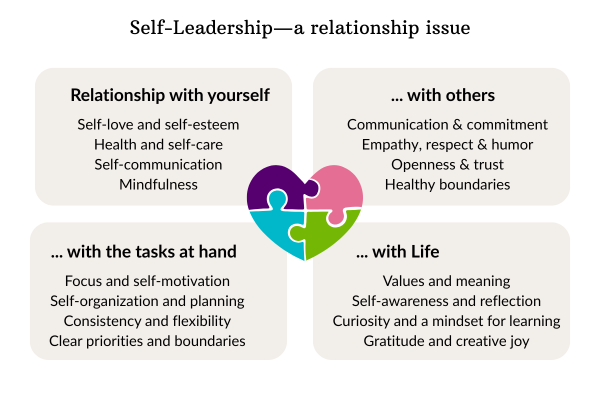
In practice, I find four perspectives particularly helpful for reflecting on how strong and clear your own self-leadership has been so far: They reflect that self-leadership always takes place in relation to ourselves, others, tasks, and life.
Self-leadership and leading internal and external teams
In my experience, a particularly interesting perspective is that of the “internal team,” i.e., our relationship with ourselves. This is often where the deeper causes of chronic stress, work overload, or external conflicts lie. If we are not at peace with ourselves—that is, if we suffer from internal tensions such as conflicts of values—this has a massive impact on our well-being, our effectiveness, and our external relationships.
Leadership as an external professional role therefore necessarily always begins with good self-leadership. Otherwise, there is a high risk that internal conflicts will be projected externally or reenacted in the external team! Self-leadership as a skill of self-understanding and self-relationship thus takes on further highly relevant significance in the professional context.
10 principles of healthy self-leadership at work
We have seen that self-management is not a “to-do” list! It is a way of relating and interacting with yourself and the world. But what does that look like in concrete terms? How can it be put into practice?
Here are a few playful ideas that I consider to be principles of healthy self-management and “inner new work”:
- Work hard, play hard – cultivate a healthy work–life balance
- Differentiate between training, performance, and recovery phases
- Take radical self-responsibility and consciously design your life
- Live intrapreneurship – and keep the “circle of influence” in mind
- Choose focus over being “busy” – and use rhythm instead of discipline
- Cultivate strong self-organization, combined with flexibility and a learning mindset
- Know your needs, goals, strengths, and values
- Build trust, teamwork, and connected thinking
- Understand what AI can do – and what defines you as a human being, at work and in life
- Do what you love & love what you do
The one impulse that, in my experience, is the fastest path into a mindset of self-leadership or “inner leadership” is this: Be the CEO of your own life!

Inquiry: Who—or what—prompted me to write this article?
The topic of self-leadership has been burning inside me for a long time. It is one of the central themes of my work as a coach and mentor for people who carry a great deal of responsibility and struggle with stress, overwhelm, and frustration. From my perspective, this capacity for inner leadership is absolutely essential if we want to free ourselves from self-overload, loss of focus, and external control in an extremely tightly scheduled and overstimulated world.
Because behind the feeling of “too much,” of overwhelm and helplessness that so many people are experiencing right now, there is usually a deeper experience of self-loss—more precisely, the loss of a felt sense of oneself.
Self-leadership is not self-management. It is about reconnecting with inner guidance, with the inner compass that is already there.
From both a philosophical and psychological perspective, the question of what actually guides us internally—especially when questions of meaning arise—is deeply fascinating. It leads us back to ourselves. We never truly lose ourselves completely—but we often lose our inner center and allow ourselves to be led and directed from the outside.
Something interesting happens, however, when we develop an attitude of curiosity and a spirit of inquiry toward that inner instance which motivates us to engage with certain topics or causes. (And which, incidentally, may also send new ideas for blog articles in the middle of the night, despite sleep deprivation … 😉)
Conclusion: Self-leadership is not a to-do list, but rather an inner connection
Self-leadership in the age of AI begins when we stop allowing ourselves to be guided (“prompted”) by external forces and instead take responsibility for our inner orientation. This does not have to feel heavy or difficult—on the contrary! The best orientation is a feeling of curious self-attunement.
To close, I’d like to share a few reflection questions. They don’t provide answers—but on a deeper level, they can help restore that very connection with oneself:
- Where do these inner impulses come from? What is driving me internally?
- Why is this topic important to me? Which values in my life does it point to?
- What does it feel like to follow it?
- What helps me in everyday life to sense myself—and these inner impulses—more clearly again?