All You Need To Know About High Sensitivity: Traits, Causes, and Practical Tipps
Highly sensitive people are often misunderstood. It is difficult for outsiders to understand what it is like to feel “more.” The outside world’s view of high sensitivity is often deficit-oriented—which many sensitive people, with their typically weak ability to set boundaries, take very much to heart. Here is an anecdote from my life:
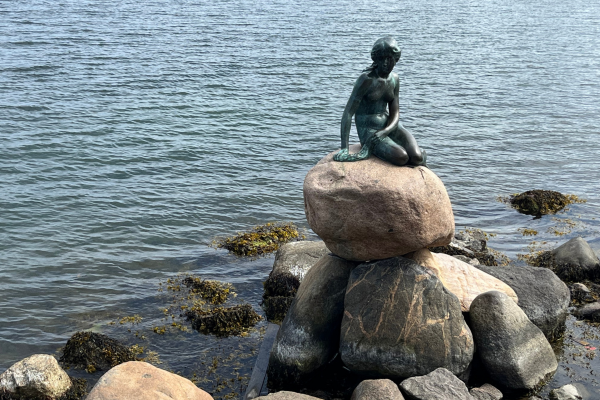
“You are like the heroine of Hans Christian Andersen’s fairy tale.”
“Oh, really?” I looked at my doctor in surprise. Heroine? Fairy tale? I was sitting in his office because of weeks of migraine-level headaches, along with sensitivity to noise and light.
“Yes…” he said and took a breath: “You are like the princess and the pea.”
He then recommended that I “change my lifestyle” (i.e., find a quiet, less demanding job).
Despite my exhaustion, I was angry and stunned—and secretly afraid that he might be right. (He wasn’t: in addition to my high sensitivity, I was suffering from advanced burnout at the time, which explained most of my acute symptoms. And then again, yes: because at some point I realized that I didn’t have to change jobs because it was too stressful for me as a sensitive person, but because it no longer fit my values and development goals—typical for a value-oriented, highly sensitive person).
Overall, the doctor was really kind and helpful—but only in terms of finally getting the correct diagnosis. I will share the story of my burnout elsewhere.
So what is high sensitivity—and why is it often misunderstood?
High Sensitivity – Often Misunderstood
High sensitivity is based on sensory openness or a low stimulus threshold in the brain’s processing centers. It is considered a character trait and does not constitute a diagnosis. High sensitivity is often completely misunderstood, even by experts – for example, one-sidedly as a weakness or “superpower.”
In recent months, people I work with—many of whom are also highly sensitive—have asked me wonderful questions about it. For example:
Is empathy always a good thing?
How can I prevent myself from hurting myself when I am so open?
I am not highly sensitive. I’m not overly sensitive, am I?
Am I crazy, or do I sometimes really know what others are feeling and thinking?
Why do I take others so much more seriously than myself? I know that’s stupid.
Is my partner or child also highly sensitive? And if so, how can I help them?
Aren’t we all overstimulated today by the many stimuli, media, and shocking news?
As a highly sensitive person, how can you protect yourself from constant stimuli and overload if you also want to make a difference? Or is it smarter to just step back?
Are highly sensitive people better or worse leaders? (Empathy vs. assertiveness)
As a highly sensitive person, am I especially prone to burnout?
This blog article is all about these questions.
Translated with DeepL.com (free version)
High sensitivity is not an illness
“You’re too sensitive!”
Some people hear this phrase often from those around them throughout their lives. Some people probably mean well when they say it, in the sense of “Don’t take it so much to heart!”
For the first three decades of my life, this always made me angry. Because, in my opinion, it wasn’t true at all. I definitely had a different self-image: that of a tough fighter! (Which I was!). I had always been able to endure a lot. More than most other people, I would even say.
At some point, it dawned on me that not everyone perceived and experienced internally what they had to “endure” like I did. Eventually, I came across the term “highly sensitive.” I was skeptical: Doesn’t that refer to those perpetually overwhelmed women who only revolve around themselves and their own feelings and always have migraines when faced with stress?
But at some point, I started getting migraines more and more often myself. And the more I read about high sensitivity and honestly looked inside myself, the clearer it became to me: this applies to me.
Little by little, it dawned on me why I was often stressed—while others seemed to remain deeply relaxed. Why I often assessed developments correctly earlier than most (and was called “Cassandra” for it). Why I love people and connection is one of my highest values—and yet I still need a lot of time to myself.
I took the usual self-tests at the time (more on that below) and they all came back strongly positive. Interestingly, although I suppress my sensitivity much less today than I did back then, I score lower on these same tests. That’s because I’ve since learned to deal with the challenges that come with high sensitivity in a completely different way—while also leveraging the strengths that come with it.
High sensitivity—just another trend?
The term “high sensitivity” was coined in the late 1990s by American psychologist Elaine Aron. She had observed—in herself and many of her clients—that some people exhibit a higher than average level of sensitivity. She coined the term “sensory processing sensitivity” (SPS) and refers to such people as “highly sensitive persons” (HSP is often used as an abbreviation and is also common in German-speaking countries). She estimates that 20 percent of all people have this trait. This is also the figure cited by many sources. However, figures of up to 10-15 percent are also often cited.
According to general understanding, high sensitivity is not an “illness” and therefore not a diagnosis. Rather, most people consider it to be a “character trait.”
The basic definition is: increased sensitivity of the nervous system, greater openness of perception + deeper processing.
Research – room for improvement
Unfortunately, research in this area is still in its infancy, mainly because the phenomenon is not considered a medical condition and therefore faces funding challenges. Nevertheless, there are already a number of exciting studies! Here is an overview page of studies dealing with high sensitivity (in German). Here is another research reader from the Ruhr University Bochum, Department of Genetic Psychology.
High sensitivity is by no means synonymous with weakness—rather, it is a strength and offers valuable inspiration in many areas for individuals, their environment, and society. At the same time, it is deeply subjective and difficult to measure. Conversely, it is not an excuse: many highly sensitive people discover a deeper meaning in it that enables them to make a special contribution to the world.
And it is not a trend, as this character trait has always existed. It also appears to occur in the animal kingdom.
Nevertheless, the term has been used inflationarily by many in recent years—by the media, coaches, and those searching for meaning.
For some, this has led to strange interpretations and identifications, and one could almost get the impression that HSPs are a kind of superhuman or messengers sent to save humanity (“starseeds”). Or as victims of their overly sensitive perception who can only learn to survive with the help of intensive coaching. And then there is the faction that sees high sensitivity as a superpower and equates it with multi-talentedness and giftedness. (As far as the secret “superpower” is concerned, I agree!)
Are non-highly sensitive people insensitive? Not at all!
Ultimately, in my view, all people are capable of high sensitivity. This can be seen very clearly in babies and children. However, in my opinion, the main difference between “normally sensitive” and highly sensitive people is that the latter perceive more and more, while the majority of adults can deliberately engage with a sensation or perception and then feel it just as “finely” and empathetically, but have much more choice about it than HSPs.
People with normal sensitivity are just as capable of deep sensitivity—if they want to be. The difference between them and highly sensitive people is that the latter cannot consciously switch their sensitivity on or off.
Some people also seem to lose their sensitivity as adults—but certainly a lot is also repressed and split off.
After all, who likes to think of themselves as overly sensitive?
Me, sensitive?! Why many people don’t see themselves as highly sensitive
Sensitive, delicate, weak, unable to cope with stress, overly emotional, irrational, hysterical, soft, self-centered, evasive, pain-sensitive, lax, weak-willed, unfocused, overwhelmed
All of these are attributes that are generally associated with “sensitive” in everyday language.
If you take a closer look, almost all of them are associated with strong negative connotations. And if you ask yourself who might be described in this way, the image of a woman will pop into most people’s minds. Sensitivity is strongly associated with femininity. And it has been devalued by patriarchal society for thousands of years.
High sensitivity as career poison and self-confidence damper
No wonder men find it particularly difficult to admit to themselves that they are “sensitive.” Especially if they grew up with a traditional role model, they have a real dilemma!
But even for women, the label is highly unattractive—and potentially damaging to their careers!
Above all, because most of them, like me, have a completely different self-image and self-perception. They are not weak!
The power of words: what is the right name?
They are highly committed, responsible, hard-working, and often performance-oriented and idealistic. They regularly go far beyond their own limits and even “normal” limits…
However, this is often done in an unconscious effort to hide or compensate for something they were shamed for as children: “Don’t be so sensitive!” “Don’t be such a baby.” “Pull yourself together.” “That’s not how it is” (highly sensitive people have a keen sense of truth and lies; in the family system, they often become privy to secrets and at the same time are denied in their perception).
Nevertheless, most HSPs—even if they reject the label or don’t recognize it as applying to them—feel that, in addition to some challenges, they also have rare strengths: such as networked thinking, a special empathy, or keen intuition. Many also enjoy the intensity of their perception—for example, in art, music, or food.
I therefore prefer terms such as “sensitive,” “highly sensitive,” “intensely perceptive,” and “deeply empathetic” to “highly sensitive.”
Nevertheless, “sensitive” hits the nail on the head: highly sensitive people are sensory and emotion-oriented.
The three main axes of high sensitivity
Some people have laser-like focus. And they can switch between external input and focused internal thinking.
It is precisely this “switch” between ‘open’ and “closed” that highly sensitive people lack… or have a very loose connection. HSPs can still concentrate deeply and process information very thoroughly. But to do so, they need to block out stimuli.
This simple image should help to better understand one of the “basic attitudes” of highly sensitive people: sensory openness. Light, sounds, smells… all of these are perceived intensely. The stimulus threshold in the brains of highly sensitive people is lower than in people with normal sensitivity. We all receive approximately 11 million sensory impressions per second via our senses. For most people, not even a hundred of these reach their consciousness. But HSPs perceive more consciously than others – and find it difficult to “defend” themselves against it!
This naturally leads to an overload of the brain’s processing capacity – and thus to a permanent activation of the sympathetic nervous system (stress axis): because an excessive amount of information that cannot be fully checked for danger or safety in the brain activates the nervous system’s alertness (in other words: you could have overlooked something dangerous or relevant).
The second axis of information processing that differs between HSPs and “normally sensitive” people is the depth of information processing. One can imagine this as the brain going through undigested information multiple times to see what might still be relevant and connected to other perceptions. This type of associative and holistic processing of impressions and experiences often leads to diversity of thought and ideas (creativity), but also to “intuitive” insights and networked thinking. (One could also say that the boundary between consciousness and subconsciousness is more permeable).
A third characteristic is the particularly pronounced capacity for empathy in highly sensitive people. This may be related to more strongly activated mirror neurons, a more refined emotional perception, or a side effect of networked thinking, which allows them to empathize deeply with others.
Put negatively, these basic attitudes mean that HSPs often find it difficult to set boundaries: between sensory impressions, feelings, and expectations of other people and their own inner perceptions, expectations, and ideas.
And this constant flood of impressions can in turn lead to constant effort and even a deep feeling of being overwhelmed and overburdened.
It is obvious that there are significant overlaps with aspects of autism and ADHD—multiple “diagnoses” are not uncommon. Many therefore consider high sensitivity to be part of the neurodivergence spectrum. Nevertheless, there are also many things that distinguish high sensitivity from these disorders. Above all, high sensitivity is not a diagnosis!
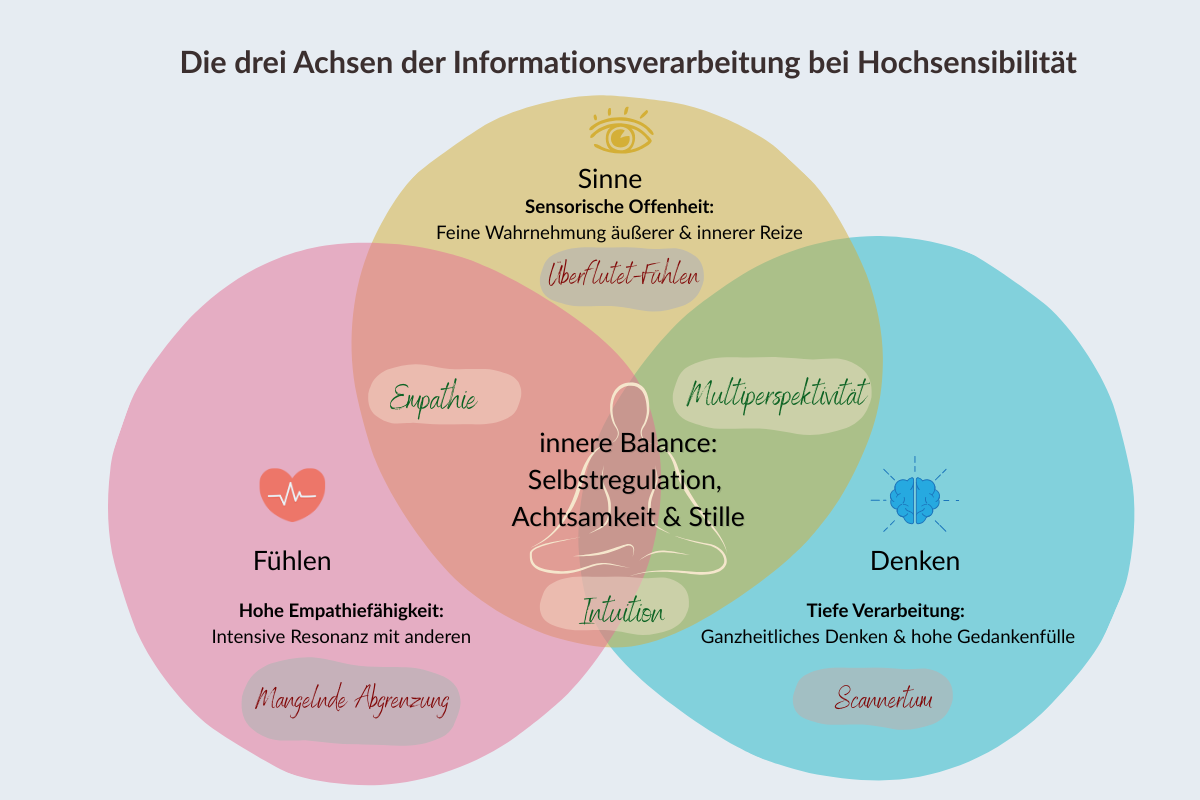
Overview: 3 axes of information processing
SENSES – sensory openness: perception of a multitude of external and internal stimuli with a permeable boundary between “conscious” and “unconscious”
-> Weakness: feeling overwhelmed
-> Strength: creativity, intuition
THINKING – deep processing: holistic and associative thinking, including a wealth of ideas
-> Weakness: concentration problems, scanning behavior
-> Strength: multipassionate and networked thinking
FEELING – high empathy: intense feeling and compassion
-> Weakness: lack of boundaries and assertiveness
-> Strength: connectedness, caring, and value orientation
On the “lack of healthy selfishness”
Are highly sensitive people always closet Mother Teresas? Probably not always—but based on my observations (of myself and highly sensitive clients): very often!
Idealism, altruism to the point of self-harm, and a very keen sense of justice seem to be part of the basic makeup of highly sensitive people:
Values & idealism: strong need for consistency, suffering from inconsistency and injustice
Ambivalence & difficulty making decisions: “built-in multi-perspectivity,” difficulty focusing on one’s own position
External orientation: often focused on others or the environment, less on one’s own needs
These are basically very positive qualities—but they can make life extremely difficult for those affected, especially if they find themselves in an environment that does not share their high values and standards and does not appreciate their commitment.
This suggests that these traits do not only come from the sunny side of the psyche, but at least in part also from the “wound” that often accompanies high sensitivity. (I will discuss the possible context of HSP and trauma in more detail below).
Empathy and altruism as a “consequence” of neurobiology?
Let’s start with the more biological side: Due to HSP’s strong external orientation resulting from high sensory stimulation, they develop the habit of focusing their attention more on their surroundings than on themselves at an early age. As sensitive as HSP are to others, they are often poor at sensing themselves. Not because they can’t – on the contrary. But because their external orientation takes precedence, so to speak, in terms of perceived relevance.
This can also be explained in terms of evolutionary biology: we only turn our full attention to our inner selves when we feel safe externally. Or when we are forced to do so by strong internal sensations such as pain. It is therefore not unusual for HSPs to be particularly sensitive to pain: their system has learned that it must “cry out” in order to get attention.
Low self-esteem as a secret inner driver
But sometimes there is also an emotional or psychological dynamic behind the preference for external needs over one’s own. And this is where it gets tricky: in many cases, the extreme external orientation of highly sensitive people hides a low self-esteem from themselves. In other words, they derive a sense of worth from caring for others, from thinking and feeling with them – and from “achievement.” Many highly sensitive people have a basic feeling of “I’m not good enough,” and this is often the secret inner driver behind their great altruism—alongside a genuine, deep capacity for empathy, which is also conditioned by their openness and sensitivity of perception.
Are HSPs particularly prone to burnout?
When people push themselves beyond their limits for years in order to be there for others, they can also experience “empathy fatigue” – a kind of HSP burnout in which those affected fall from a feeling of strong inner meaning through helping others into cynicism and inner emptiness – which can certainly manifest itself as depression.
Incidentally, highly sensitive people are particularly prone to burnout for another reason: they quickly suffer from complete sensory overload, from which they cannot protect themselves. Added to this is their high level of empathy, strong sense of responsibility, keen sensitivity to values, and performance orientation.
On symbiosis and dysbiosis
This also leads to an intriguing explanation as to why highly sensitive people so often become deeply entangled in relationships with narcissists: both know the same primal wound—a lack of self-esteem. Narcissists compensate for this through dominance and power manipulation. Empaths do so by making themselves useful and being needed. Both are, in extreme cases, dysfunctional attempts to obtain external validation for the inner pain of low self-esteem. The strategies complement each other perfectly, often resulting in an unfavorable and unhealthy symbiosis—but ultimately also offering the chance to face the core problem head-on.
Am I highly sensitive? The most important test questions
5 simple questions that provide strong indications of high sensitivity
- Do you react strongly to sensory stimuli (light, noise, smells)?
- Do you often sense other people’s moods and expectations more clearly than your own?
- Do you have an intense emotional inner life and strong intuition?
- Do experiences resonate deeply within you—be it music, encounters, or thoughts?
- Do you find it difficult to make decisions because you see many perspectives at once?
Many HSPs also feel their difference intensely and sometimes feel like “aliens”: very alone in a society that seems to be designed for a different type of person!
Where does high sensitivity actually come from?
The role of genetics
As we have already seen, neurobiology plays a role in high sensitivity—and there is evidence that this trait is genetically inherited. Studies have also shown that a certain proportion of the animal population—estimated at 15-20 percent—reacts more sensitively to stimuli than the average for the species. The theory is therefore that high sensitivity has evolved as a helpful trait for the overall population of the species, as sensitive herd members, for example, perceive dangers earlier and more acutely. This is a survival advantage, especially for prey animals and vulnerable species such as humans.
Environmental influences as formative factors
Michael Pluess’s “Differential Susceptibility Model” posits that highly sensitive people are more receptive to environmental influences – both good and bad.
In stressful environments, they are at greater risk of stress, anxiety, and overload. In nurturing environments, they develop great strengths (resilience, creativity, empathy, leadership).
It has also been mentioned that in many cases, acquired hypersensitivity or high sensitivity is also present. If people experience difficult attachment styles in their early years due to their closest caregivers, this can result in attachment trauma. Caring for others then clearly stems from the child’s attempt to create exactly what it needs in an environment that is experienced as chaotic and uncaring: a feeling of security and belonging. Or a child experiences violence—verbal, psychological, or physical abuse or threats, for example, from mentally ill relatives—and learns to be very vigilant about their surroundings. This trait is then called “hypervigilant”—a typical characteristic of trauma. In terms of intensity and accompanying symptoms such as dysregulation, panic reactions to triggers, flashbacks, or nightmares, however, trauma differs significantly from “normal” high sensitivity!
In my view, not all HSPs are traumatized. High sensitivity has various causes and is a spectrum. And many of the difficult aspects can be positively influenced, or you can learn to integrate them well and even use them as explicit strengths!
In many cases, however, I believe that innate high sensitivity “promotes” a traumatic reaction to experiences or observations in life, as sensitive people also react more deeply emotionally than neurotypical people.
Which brings us to the question: Are highly sensitive people neurodivergent?
HSP and neurodivergent?
Many experts classify high sensitivity as part of the neurodivergence spectrum. Neurodivergence refers to a deviation from the typical neural processing of information and impressions. The best-known forms of neurodivergence are ADHD and autism—both of which are also mental health diagnoses. High sensitivity, on the other hand, is not a diagnosis.
In my opinion, classifying high sensitivity as neurodivergence is appropriate. This is especially true since modern mental health diagnoses—such as those in the ICD 10 or ICD 11—are all based on observable phenomena and not on different explanatory models. The criterion for determining whether something is a disorder is usually whether it is associated with psychological distress and problems in everyday life. This can apply to high sensitivity just as much as it does to ADHD and autism – but it does not have to (as is the case with these two disorders).
Digression: Benefits and risks of diagnoses
In my opinion, we need to take a different view of mental health diagnoses and classifications! The advantage of having a diagnosable condition is, on the one hand, the possibility of receiving more targeted support in dealing with it—for example, within the healthcare system. On the other hand, another possible advantage is that, in the context of work, for example, it is possible to demand that, in the interests of equality, equal opportunities, and participation, the framework conditions of work be adapted in such a way that neurodivergent people are not disadvantaged.
However, there are also disadvantages: there is a risk of stigmatization and exclusion from certain career paths. There may be disadvantages to taking out certain types of insurance if you have a diagnosis (for example, health insurance or disability insurance may exclude the entire mental health area from insurance coverage in the case of pre-existing conditions – with far-reaching consequences when you consider that mental illnesses of all kinds are among the most common reasons for incapacity to work).
A diagnosis can also be a relief and help to better understand certain things, develop more self-awareness, and facilitate communication with others about special needs. At the same time, however, there is also the danger of those affected over-identifying with a diagnosis, which can then lead to a resistance to any kind of social classification and orientation towards norms – or even to a justification for a passive victim mentality towards life.
Personally, I therefore think it is good that high sensitivity is not a diagnosis. Especially since, despite the undoubted psychological strain that is often present, I do not see it as a collection of deficits and symptoms – any more than I do in autism and ADHD. Rather, I see it as a huge resource and many individual “superpowers” that those affected usually have to learn to use in the course of their lives instead of suffering from them.
Public discussion of these issues is both valuable and important, as it also increases mutual understanding and awareness of the potential that lies within these characteristics!
“Neurodiverse” is not the same as “neurodivergent”
A helpful classification is that all humans are “neurodiverse”—that is, we are all neurobiologically different, or diverse. No two brains are alike. The connections between billions of nerve cells are completely unique in every human being. In contrast to this neurodiversity, neurodivergence refers to people who deviate more or less significantly from the average.
But the question of what exactly is “neurotypical” is, in my opinion, at least as exciting as the discussion about neurodivergence itself!
Similarities and differences between ADHD, autism, and HSP
These three forms of neurodivergence share some characteristics:
- They can appear to be very creative, intelligent, and particularly sensitive.
- They share a tendency to be overwhelmed or misunderstood by “normal” systems.
- There is particular overlap in terms of sensitivity to stimuli and social stress.
However, there are different emphases and some distinctive features:
- ADHD: problems with impulse control and attention management, sometimes also hyperfocus
- Autism: different social information processing, meltdowns, masking, strong special interests
- HSP: keen perception, deep processing, rapid overstimulation, high empathy and intuition
Most of the keywords mentioned also occur in other forms of neurodivergence. But my impression is that there are focal points that ultimately distinguish the characteristics from one another.
To put it simply (and this is my opinion, not scientific consensus!):
High sensitivity is primarily an increased range of perception and depth of experience (filter issue),
ADHD is a more associative and creative focus of attention (control issue), and
autism is a particularly detailed way of processing information (depth of detail issue).
At the same time, it must be said that many neurodivergent people have several characteristics in parallel. Many HSPs also have ADHD and vice versa. Many autistic people are also highly sensitive, and many highly sensitive people mask like autistic people, etc.
Researchers are investigating the extent to which these similarities and overlaps are related to the fact that the brain areas underlying neurodivergent processing styles are the same. Here is an interesting review study from 2018 that deals with this issue. (Acevedo, Bianca et al. “The functional highly sensitive brain: a review of the brain circuits underlying sensory processing sensitivity and seemingly related disorders.” Philosophical transactions of the Royal Society of London. Series B, Biological sciences vol. 373,1744 (2018): 20170161. doi:10.1098/rstb.2017.0161)
Overview
| Trait | High sensitivity (HSP) | ADHS | Autism spectrum |
|---|---|---|---|
| Stimulus processing | Very sensitive and deep, quickly overstimulated | Quick & associative | Selective, thorough |
| Attention | Rather stable, except when overstimulated | Core issue: Focus, impulsivity | Often hyperfocus—immersed in detail |
| Emotions | Very empathic, resonant | Intense, often impulsive actions | Often difficult to “read” and show emotions |
| Social perception | Keen sense of nuance | Keen perception, but less adaptability | Unspoken expectations are confusing -> “masking” |
| Creativity | High, intuitive | Very high, often a flood of ideas | High, often detailed or specialized interests |
| Ability to self-regulate | Basically intact, trainable | Often impaired | Meltdowns/shutdowns possible when overloaded |
| Clinical status | Personality trait | Developmental disorder (diagnosis) | Developmental disorder (diagnosis) |
Highly sensitive behavioral types
Depending on personal life history and formative experiences, the current environment and life situation (role at work and in the family), and other personal character traits, high sensitivity can manifest itself in quite different ways in behavior:
- Cautious Empathics: These people are often quiet understanders and are very sensitive to moods and expectations of others, as well as many subtle nuances. However, they are quickly overwhelmed by various stimuli in social situations and protect themselves by withdrawing. Due to their self-isolation, they often suffer from loneliness and miss out on many wonderful moments of interaction as well as professional opportunities. They know that they are more sensitive than others, but unfortunately often perceive this as a burden rather than a strength, especially since they are also greatly misunderstood socially. Often, the development of the current situation also leads to increased vulnerability. This type most closely corresponds to the cultural stereotype of high sensitivity.
- Creative scanners (high sensation seekers): This group is characterized by a wealth of ideas and high creativity. This type—to which I also belong—loves not only quiet tones, but also high intensity. In my opinion, there is a lot of overlap here with ADHD—and dealing with this can also bring many exciting insights into oneself. The challenge is that the scanner trait often leads to exceeding stress limits. These people are aware of their sensitivity, but often appear much more robust to others than they are, as they deliberately seek to push boundaries and often have an enormous, socially admired output.
- Empathic systemic thinkers: People with this personality type are very capable and responsible. They are both sensitive and tough—often sharp-minded and quick thinkers who can anticipate developments. They continue to “function” outwardly, even when they are suffering inwardly. This, combined with their ability to seismographically detect unspoken expectations and strive to exceed them, carries a very high risk of burnout. These people often do not see themselves as sensitive, as they are extremely ambitious and work hard. They consider their finely tuned emotional side to be a nuisance and shut it off in order to function – except when they are there for others with excessive empathy. Their identification with not wanting to be sensitive is so strong that in a crisis with a drop in performance, their self-image is completely shattered.
Of course, there are experts who differentiate between types of high sensitivity in other ways—such as Patrice Wyrsch, who differentiates according to the degree of vulnerability or functionality/competence in dealing with it. In my view, understanding the concept of vulnerability is essential! Because it also shows ways to deal well with individual vulnerability—in other words, to become more resilient. There is an exciting study that shows that mindfulness or MBSR (Mindfulness-Based Stress Reduction according to Jon Kabat-Zinn) helps HSPs to regulate themselves better – i.e. to suffer less from their high sensitivity. (Soons, I., Brouwers, A., & Tomic, W. (2010). An experimental study of the psychological impact of a Mindfulness-Based Stress Reduction Program on highly sensitive persons. Europe’s Journal of Psychology, 6(4), Article e228. https://doi.org/10.5964/ejop.v6i4.228)
Other experts distinguish between types based on the sensory channel that is perceived as particularly sensitive. I think it is very important to know which channel is the most sensitive for you, as this is often the channel through which our intuition prefers to communicate.
And, of course, you can also use a gradual typology of high sensitivity. However, since the degree of sensitivity depends heavily on how self-effective, internally integrated, and mindful HSPs are, the degree of externally observable “sensitivity” may differ more or less strongly from the actual internal sensitivity.
“Robust and highly sensitive” – is that possible?
Highly sensitive people can also be highly functional—if they have learned to regulate themselves, set healthy boundaries, and are well aware of their deep needs and strengths. However, “highly functional” does not mean conforming to the norm, as this tends to promote self-denial and thus the risk of burnout. Rather, it is about integration and healthy self-management.
Personally, I am certainly far from appearing “robust.” But I am strong—or rather, “self-integrated.” My doctor from back then would probably hardly recognize me, so differently do I deal with my sensitivity today!
For decades now, I have been exploring mindfulness, yoga, philosophy, relationships, and psychology—as well as my hidden inner drivers. In this way, I have ultimately brought my inner system into harmony and lovingly respect both my strengths and my weaknesses. My self-esteem is no longer dependent on my performance or my “usefulness,” and I have resolved my value conflicts around the topic of work by fundamentally changing course and now doing what truly fulfills me with deep meaning: namely, supporting other sensitive people in tapping into their sensitive and empathic power!
In this respect, I am convinced from my own experience that sensitive strength can be learned—hence my motto, “sensitively strong!” This strength is not a “bulletproof status,” but rather a new kind of inner balance for which there are some essential areas of learning!
Becoming sensitive AND strong – how does that work?
To get straight to the point: simply reading good advice is not enough. HSPs need to learn to take themselves and their needs seriously and to take good care of themselves. Investing time and energy to learn a new way of dealing with this trait of high sensitivity… in the midst of life, with emotions, bodily sensations, and thought processes.
I also think it’s important to say that no one has to do this alone—there are wonderful resources such as courses, coaching, self-awareness formats, and much more. In my work as a coach, I also accompany many highly sensitive people. However, very few of them come to me because of their high sensitivity, which is logical: high sensitivity itself is not the problem. But if you haven’t learned to take good care of yourself, a number of other challenges can arise.
These learning areas are fundamentally important for highly sensitive people
- Mindfulness & self-regulation: learning to calm the nervous system, and cultivating presence
- Safe spaces: places, relationships, and work environments that do not cause constant stress
- Healthy boundaries & communication: feeling and expressing your needs, learning to say “no”
- Developing a value compass: aligning yourself with what feels right and important to you
- A fitting professional life: you can’t go against your own nature in the long term. A toxic environment or even just an open-plan office, constant pressure and fluorescent lighting are unhealthy for HSPs in the long run
- Self-care & energy management: Sleep, breaks, rhythm, nutrition, exercise – these are all essential basics that HSPs should take just as seriously as their lofty goals
- Use resources: Nature, music, animals, creative expression, exchange with like-minded people
- Trust: in your own deep strength, which is not classic stability, but lively balance
- Community: Exchanging ideas with other sensitive people normalizes, connects, and inspires
Conclusion: High sensitivity is not a weakness, but a special gift
The key is to consciously embrace sensitivity as a trait. In my view, the greatest gifts of high sensitivity are:
- deep sensitivity, which brings great vitality and the ability to enjoy life
- an open-minded attitude that reveals exciting details and new aspects
- a high capacity for empathy, which enables deep connection
- keen intuition, which clearly signals consistency and serves as a strong inner compass
- networked, holistic thinking, which reveals hidden connections
- great creativity, which merges inner vision and external impulses into exciting creations
- empathic and value-oriented power—a leadership style that is urgently needed in the world!
What do you think are the gifts of high sensitivity? What surprised you in this article—did you gain new insights and perspectives? If you are highly sensitive, what is your relationship with this trait today? How did you get there, and what helped you? Feel free to share in the comments!